

Over the past week, various media reports revealed how far the two South Korean shipbuilders have progressed toward securing US Navy (USN) contracts. Less visible but equally important is what these developments mean for other foreign shipbuilders that have been eyeing the same market.
Trump Names Hanwha as FF(X) Partner
During his December 22 remarks at Mar-a-Lago, President Donald Trump stated: “Last week, the Navy announced a brand new class of frigate and they’re going to be working with South Korean company Hanwha.” He referred to Hanwha as “a good company” and cited its USD 5 billion investment commitment to its shipyard in Philadelphia.
This quote amounts to a statement of intent, not a signed contract. However, it is noteworthy since it is the very first time the US government has publicly acknowledged that Hanwha has been welcomed into the US naval shipbuilding community.
In order to reach this important milestone, Hanwha tread down a path that many viewed as highly aggressive and risk-laiden (more on that below). Nevertheless, Hanwha stayed the course and emerged a winner. Hats off to Hanwha for betting big when others hedged.
Below is the current status of Hanwha’s US footprint:
Hanwha Philly Shipyard (Philadelphia, PA): Prior to Hanwha’s acquisition in 2024, Philly Shipyard was a commercial shipyard. Hanwha’s USD 5 billion investment pledge reflects the extensive scale of modernization required to transform it into a naval shipyard. It’s important to note that Hanwha Philly Shipyard has reportedly applied for facility security clearance, which would allow the yard to build vessels for the US Navy.
Austal USA (Mobile, AL): Hanwha has influence over Austal USA as the largest shareholder of its parent company, Austal. While Hanwha doesn’t have control over the Alabama shipyard, it could consider a highly intimate partnership. Austal USA already possesses experience building the Independent variant of the Littoral Combat Ship (LCS), a class of naval vessels with displacement comparable to the FF(X).
HD Hyundai’s JV with HII (and Babcock?)
On December 19, 2025, the Wall Street Journal published the following statement from HII: “We are currently in discussions with our international shipbuilding partners to explore a joint venture that would significantly expand shipbuilding capacity in support of the future fleet. This would include outsourcing support to HII’s current programs as well as potentially serving as the second Frigate shipyard.”
The statement likely refers to HII’s two international partners, HD Hyundai and Babcock. Here’s a quick glance at HII’s two partnerships:
HD Hyundai signed a memorandum of understanding (MOU) with HII in April 2025 to share best practices, improve cost efficiency, and explore opportunities to expand US shipbuilding capacity. That initial agreement deepened in October 2025, when the two companies executed a memorandum of agreement (MOA) focusing on four key priorities, which included strengthening the US shipbuilding industrial base through joint investments.
Babcock signed a memorandum of understanding (MOU) with HII in July 2023 to collaborate on naval and civil nuclear decommissioning and construction opportunities in the US and UK, with a particular focus on supporting the AUKUS partnership. That initial agreement deepened in December 2025, when the two companies executed a contract authorizing Babcock to build complex submarine assemblies at its Rosyth facility for Virginia-class Block VI fast-attack submarines.
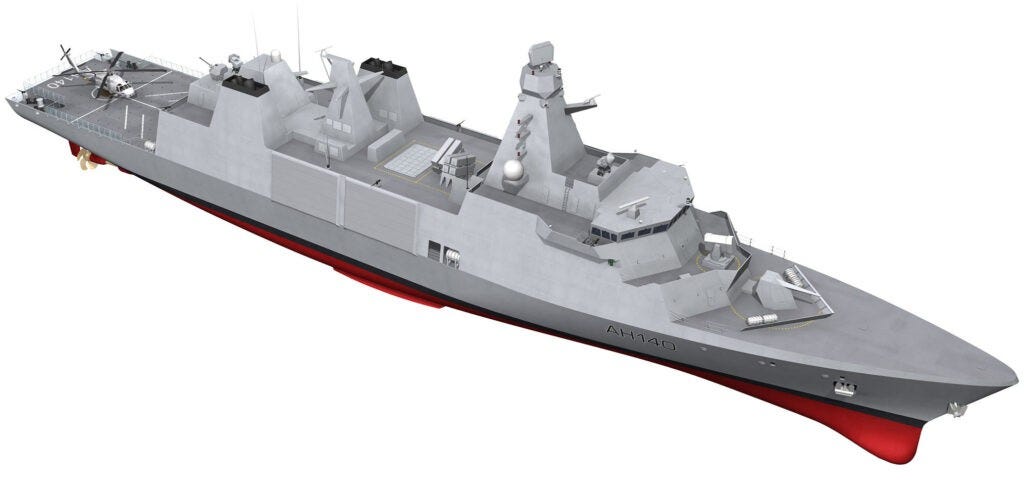
If this trilateral JV materializes, it would bring together HII’s USN prime contractor relationships, HD Hyundai’s world-class shipbuilding efficiency, and Babcock’s engineering expertise and experience with various UK Royal Navy surface combatant programs. Furthermore, both foreign shipbuilders would bring with them extensive track record with frigate construction (i.e. HD Hyundai with South Korean FFX program, Babcock with Type 31 and Arrowhead 140 frigates).
Window Narrowing for Other Foreign Shipbuilders
These developments suggest the path forward has grown more constrained for other foreign shipbuilders that have previously expressed interest in the US naval market.
The core problem: target scarcity.
Meaningful participation in USN shipbuilding requires either acquiring an existing yard with relevant infrastructure and workforce or partnering with an incumbent prime contractor. Austal USA was arguably the most attractive independent acquisition target, and is now within Hanwha’s sphere of influence. HII may have a formalized shipbuilding partnership with HD Hyundai and Babcock. Fincantieri already controls Marinette Marine.
What remains? Bollinger Shipyards operates numerous Gulf Coast facilities, but there’s been no indication the privately-held company is open to foreign acquisition or partnership. General Dynamics’ Bath Iron Works and Electric Boat are not realistic targets, as General Dynamics won’t sell its core shipbuilding business, and it is unlikely that the Committee on Foreign Investment in the United States (CFIUS) would approve such a transaction.
There’s also the legal and political dimension. Title 10 U.S. Code § 8679 prohibits construction of USN vessels in foreign shipyards, and there’s no indication yet on whether the US Congress will change this. Even if the statute were revised, contracts flowing overseas could face significant opposition from labor unions, congressional delegations from the shipbuilding states, and an expansive network of domestic suppliers. The South Korean shipbuilders understood this, which is why they prioritized US presence over legislative uncertainty.
Foreign competitors attempting to replicate their approach today would find far fewer options available.