

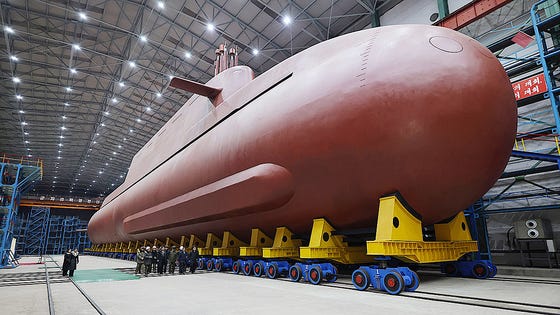
On Christmas Day, North Korea released imagery purported to be a new ballistic missile submarine (SSBN). While Kim Jong Un intended these photos to serve as a boast of military might and a tool of intimidation, a closer look suggests the retrograde design may have inadvertently exposed critical limitations in his regime’s shipbuilding capabilities.
However, as I argued in a previous article (‘Tracking North Korean SSBN’s: Why Diesel Boats Won’t Cut It’), dismissing this SSBN would be dangerously foolish. As long as this SSBN retains the ability to submerge, sail, and remain at sea, it presents a formidable concern for South Korea and the wider security architecture of the Indo-Pacific.
Blast From The Past
The most striking feature of this new platform is its elongated sail, which appears to extend across approximately 40-50% of the hull’s total length. This isn’t innovative naval architecture. Rather, it represents a throwback to 1950’s-era Soviet designs, specifically the Golf- and Hotel-class submarines.
These early Soviet boats utilized similar sail-integrated missile tube configurations, housing ballistic missiles within an extended conning tower because the pressure hull itself couldn’t accommodate them vertically. It wasn’t long before such designs were recognized as fundamentally flawed, and universally abandoned by the mid-1960’s. The massive hydrodynamic drag resulted in poor maneuverability and limited submerged speeds. Perhaps most critically, the configuration created exceptionally high acoustic signatures.
By 1967, every major nuclear power had transitioned to the integrated pressure hull design for new construction. The Golf- and Hotel-class boats, while remaining in service for years afterward, represented a design approach that was already obsolete by the mid-1960s.
“Good Enough” Deterrent
Despite the aforementioned limitations, Kim’s SSBN platform supports the “good enough” approach: fielding an operational asset now rather than waiting years for an optimized design. Furthermore, the vessel’s likely operational theater, the East Sea (Sea of Japan), may offer “home field” advantage that partially mitigates its acoustic flaws. The East Sea’s deep waters and pronounced thermoclines create acoustic “shadow zones” where sound waves refract, potentially allowing even a noisy submarine to remain undetected.
The Case for South Korean SSNs
The existence of this flawed design strongly suggests that North Korea is playing a long game. This platform is most certainly a stopgap measure, buying the regime operational capability and at-sea experience while its shipbuilding infrastructure matures.
For South Korea, the images should serve as a wake-up call. While this platform may not be cutting-edge, it reflects a clear commitment to establishing a sea-based nuclear deterrent. As I argued in a previous article (‘In Defense of South Korea’s Nuclear Submarine Program’), countering a roving SSBN places a premium on sustained, covert undersea presence, something that only a nuclear-powered attack submarines (SSN) can do. Kim’s latest SSBN update only reinforces the case for accelerating South Korea’s own SSN program.