

Earlier today, Huntington Ingalls Industries (HII) announced that the US Navy selected its National Security Cutter (NSC) design for the service’s frigate program, which follows the recently cancelled Constellation debacle. Navy Secretary John Phelan framed the decision, as follows: “Built on a proven American design, in American shipyards, with an American supply chain, this effort is focused on one outcome: delivering combat power to the Fleet fast.”
A few days ago, I examined rumors suggesting HD Hyundai Heavy Industries and Hanwha Ocean were positioning to participate in this frigate competition:
HD Hyundai’s approach centered on its October 2025 Memorandum of Agreement (MOA) with HII, designed to provide technical expertise while leveraging HII’s existing US infrastructure.
Hanwha pursued both partnership and direct ownership through its stake in Austal and acquisition of Philly Shipyard.
Both shipbuilders’ strategies aimed to circumvent 10 USC § 8679’s prohibition on foreign construction of USN vessels.
In this article, I will elaborate on the following two points:
Why HII should activate the HD Hyundai MOA for the USN frigate program, in order to leverage the South Korean shipbuilder’s highly relevant expertise gained through the Republic of Korea Navy’s (ROKN) Fast Frigate eXperimental (FFX) program.
Among the South Korean shipbuilders, while HD Hyundai may have won this round, Hanwha should remain confident about its US naval market entry strategy.
Legal Boundaries
Secretary Phelan’s “American supply chain” language signals more than political messaging. Title 10 USC § 8679 prohibits foreign construction of naval vessels, and conservative legal interpretation could extend this to hull modules or structural components fabricated abroad. The statute’s purpose is to support domestic shipbuilding expertise. Allowing foreign fabrication of hull sections would defeat that objective.
The October 2025 MOA between HII and HD Hyundai covers several areas for collaboration. According to HII’s official announcement and various media reports, the agreement addresses distributed shipbuilding, modular construction, technology transfer (e.g. AI, robotics, automation), US facility investment, and auxiliary vessel construction. A senior HII executive previously described HD Hyundai as a partner that “has an excellent supply chain [and] a lot of lessons learned...from their destroyer program.”
However, in the absence of any manufacturing footprint on US territory, HD Hyundai’s potential contributions to the USN frigate program would be severely limited in scope. All that remains legally permissible may be to provide technical assistance to HII (e.g. engineering support, process improvement advisory, embedded technical experts at US facilities). That said, it’s important to note that HD Hyundai’s potential advisory role could prove far more valuable than its limited scope suggests.
The FFX Precedent: Relevant Experience to Up-Gun NSC
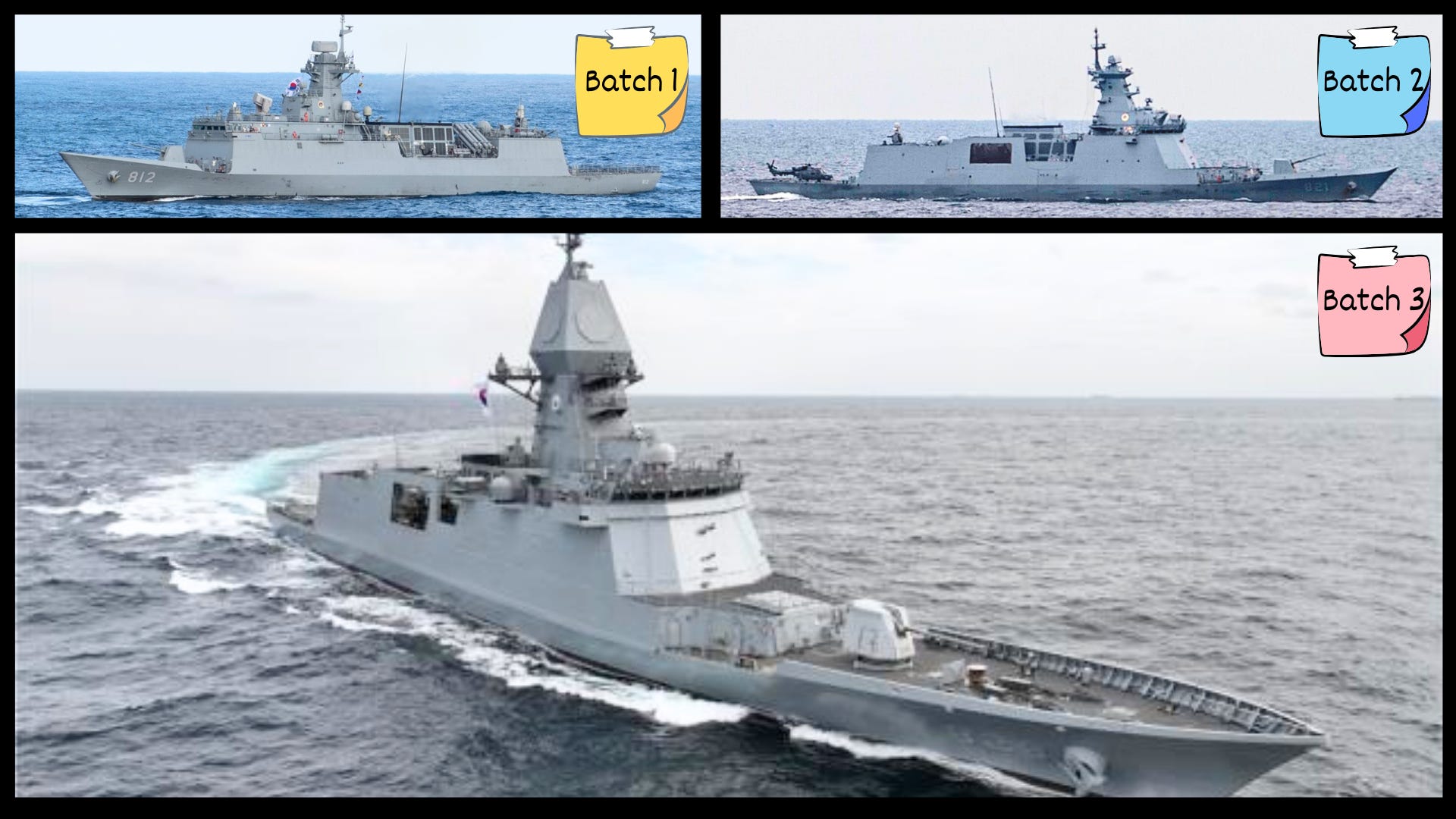
HD Hyundai’s experience with the ROKN’s FFX program demonstrates precisely the capability the USN and HII now require: successfully up-gunning a baseline coastal patrol design into progressively more capable combat platforms.
The FFX program began in the mid-2000s to replace aging frigates. FFX Batch 1 established a 2,300-ton baseline design with a noticeably modest armament package: a single 127mm main gun, RAM launchers, Phalanx CIWS, and SSM-700K anti-ship missiles. The design prioritized cost-effectiveness for coastal defense missions not unlike the Legend-class NSC’s original mission set.
FFX Batch 2 represented a significant upgrade within the same basic hull form, as the hull was enlarged to 3,600 tons while adding a 16-cell vertical launch system (VLS), towed array sonar, and hybrid diesel-electric propulsion.
FFX Batch 3 expanded further, as the 3,600-ton design featured an integrated sensor mast with a four-panel AESA radar, advanced IRST and EOTS systems, expanded VLS capacity, and provisions for manned-unmanned teaming with USVs. The Batch 3 armament — 127mm gun, anti-ship missiles, land-attack cruise missiles, anti-air missiles, and long-range ASW torpedoes — matches or exceeds many contemporary frigate designs, including the FREMM design that proved problematic in Constellation-class adaptation.
The South Korean FFX progression demonstrates HD Hyundai’s specific expertise to address the challenge HII now faces: taking a coast guard cutter hull and progressively up-gunning it without destabilizing the design. The FFX program maintained hull form continuity across the three batches while dramatically increasing combat capability. Each batch built on lessons learned from the previous iteration, managing weight growth, stability impacts, and systems integration challenges that typically derail such efforts.
HD Hyundai’s engineers could provide HII specific guidance on weight distribution for VLS installation, structural reinforcement approaches for increased top-weight, combat systems integration strategies that minimize design changes, and production sequencing that accommodates armament requirements. The company has documented institutional knowledge on exactly what HII must now accomplish.
HD Hyundai’s FFX experience, even delivered through advisory channels, provides HII a reference implementation of the process the USN now requires. The alternative would be to develop this knowledge internally through trial and error, an approach that failed with the Constellation class.
Hanwha’s Strategic Position: Ownership Matters
While prospects for Hanwha’s participation in the USN frigate program appear bleak, Hanwha should feel confident about its US naval market entry strategy.
Hanwha controls actual US production capacity through its majority stake in Austal and acquisition of Philly Shipyard. Austal USA is a US entity with facility security clearances, USN contract performance history, steel shipbuilding capability, and cleared workforce. While Austal USA did not win this frigate contract, Hanwha now controls infrastructure positioning it to compete for future programs as a domestic bidder under US law.
When the next major surface combatant competition emerges, Hanwha will likely bid as a US shipyard with South Korean ownership. HD Hyundai’s partnership with HII, by contrast, provides market access only to the extent HII chooses to utilize HD Hyundai’s contributions within narrow legal bounds.
The competitive implications extend beyond frigates. When USN auxiliary opportunities emerge, Coast Guard programs expand, or commercial work becomes available, Hanwha-controlled yards bid as primary contractors. HD Hyundai would participate only if HII subcontracts specific work, a dependent position where HII holds the leverage.
This isn’t to say HD Hyundai’s fate in the US naval market is entirely chained to HII. In recent months, HD Hyundai officials have stated in recent months that they intend to acquire a US shipyard and have been in discussions with “multiple companies.”
Conclusion
The USN chose maximum conservatism: a hull HII already built ten times, using existing tooling and production data. Whether this approach succeeds depends on avoiding Constellation’s trap of assuming a “proven” starting point prevents the design changes that ultimately cause program failure.
HD Hyundai’s FFX experience could genuinely benefit HII’s frigate development. The question is whether technical advisory relationships can effectively transfer that expertise or whether direct construction participation remains essential for meaningful knowledge transfer. Depending on whether the MOA will impact the frigate program, we may very well discover the answer to this question as HII starts tweaking the NSC design.